The Star online. Lifestyle. Parenting. Thursday May 10, 2007
Childwise
By RUTH LIEW
My daughter leaned over and whispered to me, “I will tell you something later in the car.”
I could tell something was bothering her after the waiter brought her drink. She winced when he approached her and tapped her head lightly before leaving our table. When we got to the car, she told me, “I didn’t like the waiter touching my head.”
Most adults think it is a friendly gesture to touch the heads of young children or pat their backs. Even if children are told that there is nothing wrong with such attention, they will struggle with what makes them uncomfortable.
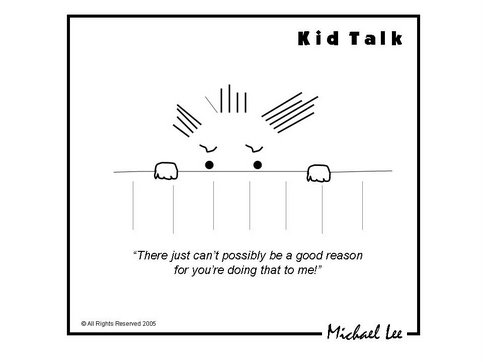
Children have the right to reject unwanted physical contact. My daughter felt uncomfortable when a stranger touched her head. She did not welcome such attention. She alerted me to the potential dangers children face when they are out in public.
Some adults try to get on friendly terms with young children, in front of their parents or guardians. They show their affability by giving the child a light pinch on the cheek, a pat on the back or even by touching his or her head.
Most of the time, parents may think nothing of it and merely smile. What parents do not realise, is that they making their children susceptible to such attention. Young children will not be able to discern right from wrong. They may get confused and become easy prey for those who want to deceive them.
I have witnessed, on many occasions, in restaurants, how some parents hand over their babies or toddlers to strangers so that they can have a meal in peace. One mother even told me proudly that her 10-month-old child does not mind any strangers carrying him. I warned her of the dangers of having her child being snatched away. Parents should constantly keep a watchful eye on their children in public places.
When my girls were babies or toddlers, I used to tell strangers who showed interest in them that they were unwell. If someone offered to help me look after my babies while I ate, I would politely refuse their kind gesture by saying, “My child has serious stranger anxiety. She is also at a biting stage.”
Now that my children are in primary school, I remind them that if someone makes them feel uneasy, they must always leave the place and seek help immediately. In fact, they can even say something obnoxious or rude to put that person off. Referring to the incident with the waiter, I even told my daughter that she has every right to say, “No! Don’t touch me!”
It is not bad manners to do so. In fact, all children must know that any adult who touches them without their permission is being disrespectful and rude. If they want to greet someone with a handshake, they must extend their own hands first and wait for the other person to respond. No one has the right to touch another person without permission.
Babies also deserve to be treated with respect. No child likes to have her cheeks pinched just because she is cute. Neither does she like getting a pat on the buttocks just because some adults cannot resist doing so.
Family members should show their affection in a respectful manner. If they want to give the child a pat on the back, they should always ask first. The same applies when they want to carry a baby or give her a peck on the cheek.
Children should be trained to tell the adults if they do not welcome a certain action done to them and insist that it be stopped. It does not matter whether the person who does it is a stranger or a family member.
Frances Carlson, who wrote Essential Touch: Meeting the Needs of Young Children, reminds parents and teachers that children who know about body ownership will be more aware of what types of touch from others they enjoy and what makes them uncomfortable. They will learn to develop an inherent control of when, where and how they are touched.
She adds that if children don't understand the concept of body ownership, they may get confused, thinking that adults can do anything to them as long as they tell them that it is not wrong. When this happens, our young children become vulnerable to abuse.
Children must be told that they are not being rude if they speak up when someone is hurting them or making them uncomfortable.
Parents must be ready to stop unwanted behaviour towards their young children. It makes no difference whether the child is a girl or boy – no adult should touch any part of children’s bodies without their permission.
Listen to your children when they tell you how they feel when someone is acting strangely towards them. Constantly repeat safety rules to your children to reinforce them in their minds.
Some grandparents, uncles or aunts may frown at being told their gestures are unwelcome. They may even accuse parents of being overprotective. However, parents should make relatives and friends aware of the fact that children own their bodies and have the right to say “yes” or “no” to being touched.
Children who are guided from young can learn to protect themselves. Parents cannot wait for “appropriate moments”. They must start teaching the child about personal safety, and what is acceptable physical contact from the time the child is able to walk and talk.
As children learn about body ownership, they will develop a sense of respect for others and will behave appropriately towards others.
Showing posts with label parenting. Show all posts
Showing posts with label parenting. Show all posts
Tuesday, 15 May 2007


Friday, 27 April 2007
2007 02: No access to their kids’ love
The Star online. News. Opinion. Wednesday February 28, 2007
A FESTIVE season is a time to be merry with our loved ones.
But in the midst of all this is a small group that suffers in silence.
They are not physically or mentally challenged, but parents who have been alienated from their children. Their children are not dead. They are very much alive, living with one parent who has been separated from the other.
Can you imagine the lingering pain and agony of an alienated parent?
The parent who has limited or no access and who can only watch from afar and observe his or her child being cajoled to hate him or her as result of an ugly divorce.
Who actually suffers? It is the child. The innocent and unknowing child is subjected to constant and systematic brainwashing followed by wilful manipulation. The purpose: to destroy a loving and warm relationship they once shared with both parents.
Parental alienation and hostile parenting deprives a child of his right to be loved and to show love to both parents.
This selfish, vindictive and malicious action must be exposed to everyone so that judges, police officers, lawyers, family, friends and society is aware this is happening. A child being traumatised is a form of child abuse.
Children affected by parental alienation suffer intellectually, physically and have deep-rooted life-long emotional problems.
Poor performance in studies, juvenile crime and mental health with the propensity for unstable adulthood are the consequences that bear immeasurable costs.
The Pemaliks, a group that pioneered Pertubuhan Mencegah Alienasi Keibubapaan (Association for the Prevention of Parental Alienation) Kuala Lumpur dan Selangor seeks to create awareness on the negative effects of Parental Alienation.
We aspire to change the mindset of those responsible to carefully weigh their decisions on child custody matters and take into consideration the effects of parental alienation seriously.
Just as the child’s interest and well-being is of paramount importance, so too is the need for undivided love and support from both mother and father.
FRANCIS YEOH CL,
Hon Secretary,
Pertubuhan Mencegah Alienasi Keibubapaan Kuala Lumpur dan Selangor.
.................................................
Fathers should also be given fair and equal treatment
The Star online. News. Opinion. Monday March 5, 2007
FRANCIS Yeoh CL’s letter to the editor (The Star, Feb 28) is a plea that has been highlighted repeatedly but continues to be ignored and treated with apathy by the powers to be.
I have been in a similar situation for more than five years and have undergone the immense suffering of not having proper access to my children while continuing to fight an expensive but losing legal battle.
Occasionally a family court judge may be sympathetic but a wily lawyer and ex-wife may coerce the children to describe in court how bad a father you are.
The fact that you have been unstinting in your efforts to gain even minimum access to your children for years or that you pay thousands of ringgit in maintenance fees every month without fail does not make a difference.
The sad fact is that it would seem to be tolerated by society and very often the perpetrator of this kind of mental child abuse would seem to be mothers themselves.
Their thirst for revenge - their overpowering anger towards their children’s father that never lessens with the passing of time - blinds them to the mental anguish suffered by their children.
I am only allowed a few words from a safe distance over a locked gate once every week and I have not hugged nor held the hands of my children for many years now.
I can see the conflicting emotions and sadness in their eyes but I am powerless.
The harsh reality is that the Government, Judiciary, NGOs etc are all intent on fighting for and protecting the rights of women and while there is nothing wrong with this, fathers should also be given fair and equal treatment by them.
SAD DAD,
Kuala Lumpur.
Subscribe to:
Posts (Atom)


